Waiting for finished hardware is a risk of its own. A glasses maker needs a battery that fits its frame, Quanta needs a reliable source of optics, and Axon wants a wireless headset for police training. Each has a reason to put money in early and some say in what gets built as a result.
Enovix has a purchase order for a battery shaped like a curved trapezoid, which tells us more about a pair of smart glasses due next year than we usually get to know this early. We don’t know whose name will be on the frame, but whoever’s making it has decided the shape is worth paying a battery engineer to get right.
I think the shape of that battery explains why the customer is picking up the engineering bill. How many other glasses makers are going to want a cell with precisely those dimensions? Asking Enovix to fund the design itself would mean asking it to take a bet on one company’s choice of frame. The deal gives Enovix a paying customer for that engineering and gives the glasses maker time to decide how many cells it needs.
A Battery Made for One Frame
Say you’ve settled on a frame you think people will actually want to wear. Paying someone to make a battery that fits the space you’ve left seems a reasonable expense, particularly if it saves you having to make the arms thicker or change the shape you liked in the first place.
Enovix expects battery production to start in the third quarter of 2027, ahead of a planned launch for the glasses that fall. Both dates tell us something about the customer’s ambitions, but it’ll take another purchase order before Enovix knows how many cells the customer will buy.
Enovix’s own books give us a handy comparison. On November 12 the company reported that it had shipped about 19,000 units against an earlier order for 50,000 eyewear battery packs, so there’s already a number a production manager can plan a shift around.
How Vuzix Earned the Last US $5 Million
Quanta Computer’s investment in Vuzix came with a factory test attached. Before Quanta paid the final US $5 million in September 2025, Vuzix had to hit targets for how quickly it could make waveguides, the thin optics that direct an image into the wearer’s eye, and how many came off the line good enough to use.
It reminds me of something Kevin Curtis, SVP of Advanced Optics at Magic Leap, told us about making displays affordable.
“A great prototype is encouraging, but the factory must be able to make it again and again.”
Just over a year later, you can see what Quanta bought into. In its November 12 results, Vuzix said its upgraded Rochester facility was running and customers had received samples of its single-plate color waveguides to evaluate.
Quanta designs and builds electronics for other companies. A reliable source of optics gives it something to offer the next customer who asks it to build a pair of smart glasses. Taking a stake in Vuzix helps bring that supplier along, and tying the investment to factory performance let Quanta see what the line could produce before putting in the full amount.

Axon Is Already in Training
Axon already sells VR training to police departments, which goes some way to explaining why it’s willing to order a wireless headset so far ahead of delivery. As The XR Beat reported, Axon has agreed to buy US $35 million worth of headsets from Varjo to use in its own training system.
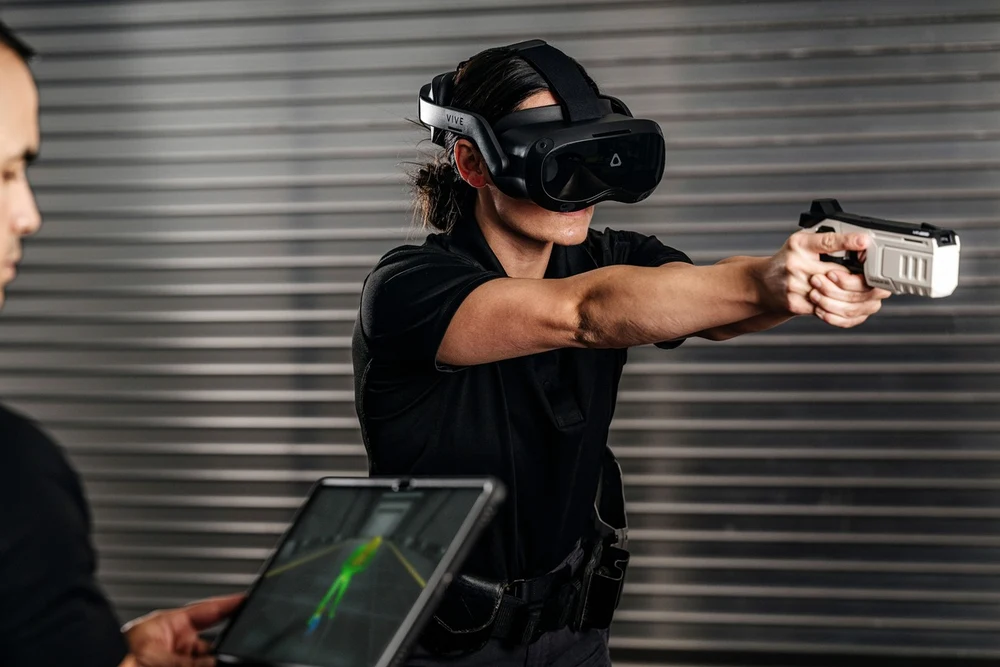
The November 18 agreement calls for deliveries to start in the first half of 2028 and finish within a year of the first shipment. That gives Varjo a buyer to plan around and leaves Axon with a rather different sales job, because it still has to persuade police departments that the new headset belongs in their training budget.
The Cost of Waiting
What interests me about Axon is that it already knows the people it needs to sell to. It can judge what a wireless headset would add to a police training session. Varjo knows how to build one. An order brings those two bits of knowledge together while Varjo still has a product to deliver and Axon still has training contracts to win.
For an XR hardware maker looking for backing, I think that changes who’s worth approaching. A company can be enthusiastic about smart glasses and quite happy to wait until they’re on sale. But maybe the more promising conversation is with the company whose frame needs your battery, or whose training business already has a use for your headset. You can ask what getting that product right is worth to them – and which part they’re prepared to back.