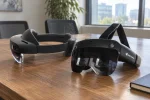
Magic Leap is pursuing larger wafers and simpler optical designs to cut the cost of waveguides for AI display glasses, as it works to supply companies building consumer eyewear.
The company’s target of $100 or less for the full display system covers both the waveguide, which guides the image towards the eye, and the light engine that produces it. Device makers also need the display to work with their chosen components and remain consistent across production runs.
In written responses to The XR Beat, Kevin Curtis, Magic Leap’s SVP of Advanced Optics, explained what reaching that target requires:
Getting the full display system near or under $100 will take progress in both the light engine and the waveguide, along with production volumes high enough to make the manufacturing economics work. A great prototype is encouraging, but the factory must be able to make it again and again.
Getting the Display Below $100
In his recent article on surface-relief grating waveguides, Curtis explains why Magic Leap chose the architecture for consumer glasses. Its SRG waveguides use microscopic structures patterned on a transparent substrate to direct light towards the eye.
At roughly half a millimetre thick, the waveguides leave room for other components and help designers keep the glasses close to conventional eyewear. Curtis also argues that reproducing these structures through a controlled wafer process can reduce manufacturing complexity and waste.
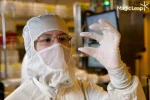
Magic Leap uses Jet and Flash Imprint Lithography, or J-FIL, to reproduce the optical patterns. In his responses, Curtis said its four-step manufacturing process is designed to reduce costs while increasing yield, the proportion of production that meets the required standard.
He also described further changes the company is pursuing:
Further gains come from making the best use of each production run. Larger wafers can produce more waveguides at once, while a simpler optical design helps bring down the cost of each one. We’re pursuing these improvements to make waveguides less expensive while keeping the image bright and clear.
Curtis didn’t provide a current display-system cost, the production volume needed to reach $100 or a timetable for achieving it. As such, manufacturers evaluating a supply agreement would still need pricing against their own design and order quantities.
What Magic Leap Learned Building Headsets
Curtis says partners are focused on consumer glasses for everyday use, including navigation and access to AI assistance. Comfortable frames and an affordable price constrain the amount of hardware they can include.
Magic Leap’s experience building complete AR devices is part of its offer to those manufacturers. Curtis described ghosting as an example of a problem that can emerge when components are combined:
A uLED display can produce a bright image, but once it’s paired with a waveguide, a faint second image may appear beside the first. The challenge is clearing up the image without sacrificing brightness.
The remedy depends on the light engine’s specifications and design. Curtis said Magic Leap can recommend changes suited to the engine a partner is using.
For a device maker, checking that combination early could help avoid redesigning the optics after other product decisions have been made. A bright microLED display still has to deliver a clear image through the selected waveguide and inside the finished frame.

Power consumption imposes another limit. Brighter images and wider fields of view increase demand on a battery that has to share space with processors, sensors and other electronics.
Asked what’s realistic today, Curtis said:
Right now, depending on what applications the device is running, manufacturers can expect roughly 8 hours of battery life at 50 grams or below.
He cautioned that reaching those figures can involve compromises in comfort or image quality. His answer didn’t identify a specific Magic Leap or partner device achieving them, or the usage conditions underpinning the estimate.
Laser Scanning – Coming Soon?
Curtis is also exploring how waveguides could work with laser scanning, which he says could support brighter images or wider fields of view without adding bulk.
The difficulty is distributing the light evenly. A laser’s narrow range of emission directions can make coupling light into a waveguide more efficient, while making uniform brightness and colour harder to achieve.
Curtis said Magic Leap is experimenting with waveguide designs and materials to address this:
We’re exploring waveguide designs and materials that could spread the light more effectively, and we’ve seen encouraging results in early experiments. We still need to show that those results carry through to a laser scanning system and a waveguide we can manufacture consistently. I’m optimistic about the direction, but I wouldn’t call it ready for a partner product yet.
Magic Leap’s Broader Pivot
Magic Leap promoted Scott Carden to COO earlier this month as it builds its business around supplying waveguides and integration expertise to other glasses makers.
The company has stepped back from first-party devices, and Carden now oversees its operating plan, including production growth and cost and performance targets. He previously told The XR Beat that his priorities over the next year include moving partner programmes closer to volume production while improving manufacturing yield and efficiency.