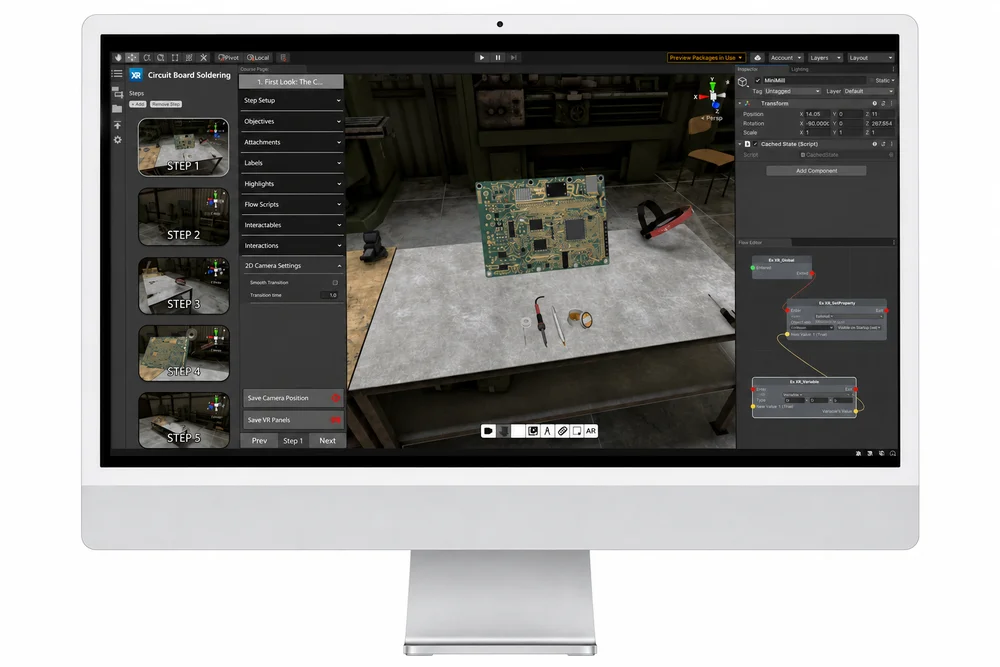
EducationXR’s desktop course editor. Image: EducationXR, adapted by The XR Beat
EducationXR is using AI to help training teams create interactive courses without commissioning every change from a developer. Faster production could make VR less expensive to use for specific procedures or smaller groups, where a bespoke build can be difficult to justify. A hospital simulation specialist is already creating and rolling out courses with the tools, according to the company.
At October’s Augmented Enterprise Summit in Atlanta, EducationXR showed me a crane-and-container exercise created using a short written prompt. I was impressed by how much of it a learner could interact with, and by the ability to keep changing the exercise through further instructions.
A bespoke VR course can be a hard sell when only a handful of people need it. EducationXR wants trainers to build and revise those courses themselves, without having to master a game engine first, which is quite a detour when you’re trying to teach somebody else.
A Crane on Request
The company’s AI Harness takes a description of an experience and can build its 3D content and interactive steps, then publish it through the EducationXR platform, according to Alejandro Castedo, Chief Product Officer.
In follow-up answers to The XR Beat, Castedo described asking for changes after trying the first version. A lever might need moving, for example, or the trainee might need to grab it rather than click it. The two versions may look much the same in a screenshot, but a trainee will certainly notice the difference.
Castedo said:
“Normally in one day you will be able to have a complete experience with back and forth updates and polish.”
The company’s published crane demonstration puts the initial build at 70 minutes, while Castedo’s day-long estimate includes the back-and-forth that follows a first attempt. Trainers would still have to check the result before using it with learners.
Does Every Course Need a Developer?
EducationXR gave a small number of customers access during AES. By October 25, Castedo said a simulation specialist at a children’s hospital had created three or four courses and begun rolling them out, covering gamified experiences and visualization, without needing a developer’s assistance.
The XR Beat hasn’t independently verified the hospital’s results. A simulation specialist is an obvious person to put these tools in front of, though: they already know how to design an exercise, without necessarily knowing how to build all its 3D components.
Castedo expects teams to need little developer assistance, although EducationXR still provides support and its artists can help with 3D content. A trainer reproducing a particular piece of machinery may have rather more to ask for than someone building a generic scene.

The Courses That Never Get Funded
Training a large audience helps spread the cost of building a VR course. PwC illustrated this in its 2020 soft-skills training study, where VR became more cost-competitive as learner numbers increased. Its figures aren’t a price guide for today’s tools, but a small team has fewer people to spread that initial bill across.
If building and editing becomes less expensive, a maintenance team could have an exercise for its own equipment, and individual sites could have their own versions. Keeping a course current might also stop requiring another round of commissioning every time a procedure changes.
EducationXR hasn’t supplied a measured comparison of total course costs, so there’s no saving to put a number on yet. Licenses, staff time and accurate 3D models still need paying for, even if the first draft arrives impressively quickly.
EducationXR isn’t alone in trying to make creation less expensive: SimInsights markets SimGenie for generating simulations using prompts or documents, while Campfire uses company manuals and 3D models to create guidance.
No Headsets? No Problem
EducationXR’s AI uses its existing creation tools, so trainers can keep editing by hand when that’s easier than explaining another change to the AI. Finished courses can run on phones and computers as well as VR headsets, and people using different devices can join the same multiplayer session.
Instructors also need to get everyone into the session, as our reporting on ManageXR Rooms explored. Browser access gives EducationXR another way to reach learners, which is handy when there aren’t enough headsets to go round.
An existing standard operating procedure can provide the starting material for a course, according to EducationXR. Castedo said subject matter experts assess the generated experiences against their usual rubrics and carry out usability studies, so the person who knows the procedure still has to check what trainees will learn.
If EducationXR can bring the cost down far enough, I’d like to see the courses trainers might previously have had to shelve, such as short exercise for one team, a version for a different site, or perhaps a procedure that changes too often to justify a bespoke build. A modest training budget ought to stretch to more than the same few simulations on repeat!