Qualcomm’s Snapdragon START program aims to help companies build smart glasses using shared electronics, software and manufacturing partners. Senior Director of Product Management Sahil Bansal explains what customers still need to develop, how a reference design could become a product, and why enterprise applications need to be specific. He also discusses Qualcomm’s plans to use XR for training and employee experiences.
Businesses interested in smart glasses may already know the application they want to offer, but building a wearable device around it brings a separate set of engineering and production decisions. Qualcomm’s Snapdragon START program supplies hardware modules, software and access to partners to help companies develop their own products.
At the Augmented Enterprise Summit in Atlanta, I spoke with Sahil Bansal, senior director of product management at Qualcomm Technologies, about the program and the practical questions behind enterprise adoption. We also discussed Qualcomm’s collaboration with UK eyewear company Inspecs on safety glasses and Cellid’s Crux reference design.
Some of Sahil’s comments about START appeared in our earlier article on how smaller companies can enter the smart glasses market.
The interview has been edited for length and clarity.
What Does Snapdragon START Provide to a Company Building Smart Glasses?
“The idea behind it is we want to basically reduce the friction for companies to be able to develop smart glass-based solutions and products.”
“They may know about glasses, on the enterprise side, they may know about their business, they may know about what are the use cases that they want to launch, but they may not know as much about the electronics and how you can bring a smart glass to life.”
He described a combination of modules, manufacturing partners and software connecting the glasses with a smartphone and cloud services. Qualcomm announced the program in June, initially focusing on smart glasses.
What Does the Customer Still Need to Develop?
“Let’s say that you have a particular ISV or an application that you want to develop that’s vertically specific and tailored toward your use case. They would have to either work on developing that application themselves, or we can help provide ISVs that they can work with.”
Qualcomm is working with some ISVs to pre-integrate solutions, while other applications may need tailoring.
An ISV is an independent software vendor. The customer would still need to specify the intended application and define requirements for the glasses. Asked whether Qualcomm would provide ongoing integration support, he said the company was looking at help and maintenance, without setting out specific commitments.
How Could Cellid’s Crux Reference Design Become a Product?
Japanese optics company Cellid joined START and showed its Crux reference design at AES. Sahil described how a business could adapt a reference design to suit its requirements, with changes potentially made by Qualcomm or manufacturing partners.
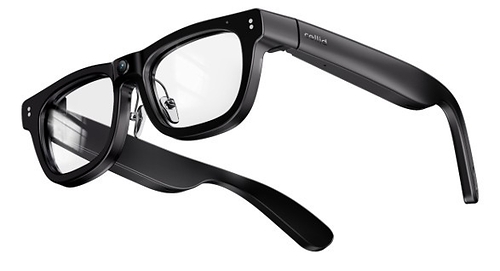
“The enterprise could say, hey, this is great, but I need maybe some changes in terms of the safety rating as an example, or I want a different color, or I want this type of software application that’s running on it.”
“So they would take that reference design and then we could work with them or they could work with their other partners that are getting this manufactured to basically make those changes.”
Crux is a reference design rather than an established customer deployment. Cellid describes the glasses as a binocular, full-color AR design built around its waveguide and display technology.
What is Qualcomm Developing with Inspecs?
Qualcomm and Inspecs showed a safety-glasses prototype at Snapdragon Summit in September. The wider solution was still in development when we spoke, with no specific availability date.
“We announced our partnership with them in June, and we showed at the Snapdragon Summit in September safety glasses that we developed in conjunction with InSpecs.”
“It has audio, mic, camera…basically they’re safety glasses that we’re working on in conjunction with them to be able to take to large manufacturing companies or other types of companies that have heavy machinery.”
One proposed application is an AI assistant that could answer a technician’s questions about machinery while keeping their hands free:
“A person can be hands-free, looking at some type of machinery, and saying, hey, what is this or what’s this part again?”
Would Shared Components Make Products Too Similar?
Shared modules can reduce the amount of electronics development a company has to undertake, but they also raise a question about how manufacturers distinguish their products.
“I think it’s really the core infrastructure and the enablement that we are providing.”
“There can be differentiation in terms of the glasses, the mechanical look and feel, fit, finish, what kind of safety rating they’re meant for.”
A manufacturer targeting a factory, for example, may need a different frame and safety specification from a brand designing everyday eyewear. The application and support around the device would also need to suit the intended users.
Which Development Costs Could the Program Reduce?
Sahil didn’t put a figure on the savings for a real project, although he explained that a shared module could reduce circuit-board and electronics design. The software could also remove the need to build certain connections from scratch.
“There’s a lot of PCB and electronic design effort that gets reduced. So that’s NRE that gets reduced.”
“There are savings on the software development where you don’t have to develop a bespoke protocol to connect the glasses to the phone and then go out to the cloud.”
NRE means non-recurring engineering, the upfront development expense of designing a product. The size of any saving would depend on the device and what its maker still has to build.
How Should an Enterprise Assess the Value?
Sahil said companies would assess the value case by case, considering the time spent on equipment and whether remote assistance could avoid the cost and delay of flying an expert to a site. He didn’t provide a measured saving from a named customer, instead describing the questions a buyer might ask:
“What’s the ROI in terms of improving the efficiency and the cycle time of a frontline worker working on some piece of either heavy machinery or some other equipment?”
“Can I have remote assistance happening through the smart glasses in real time, not have to wait for an expert to be flown in?”
“It has to solve a business need. It has to be specific and it’s not always glamorous, right?”
A remote-support pilot would still need to establish whether the connection is reliable and an expert can resolve the issue without visiting. Any savings would also have to be weighed against the cost of devices, connectivity and support.
Where Can AI Glasses Fit Alongside Existing Devices?
Sahil sees potential in combining AI with a wearable camera and microphone, particularly when someone needs information without picking up a phone or tablet. He also suggested that glasses could help salespeople recall information or transcribe meetings, although wider adoption would depend on whether people find enough value in using them.
Whether an assistant can give a reliable answer depends on the information available to it and the application built around it. In a safety-critical setting, buyers would also need to establish how the guidance is checked and what the system can verify about the equipment in front of it, a distinction explored in our feature on AI work instructions.
“If you could start making those [safety glasses] smart, and adding in the things that you might do through other means, either through a phone or a tablet or consulting a manual, if you could start automating that a little bit more through the glass and through the use of AI, that’s where I think it shines.”