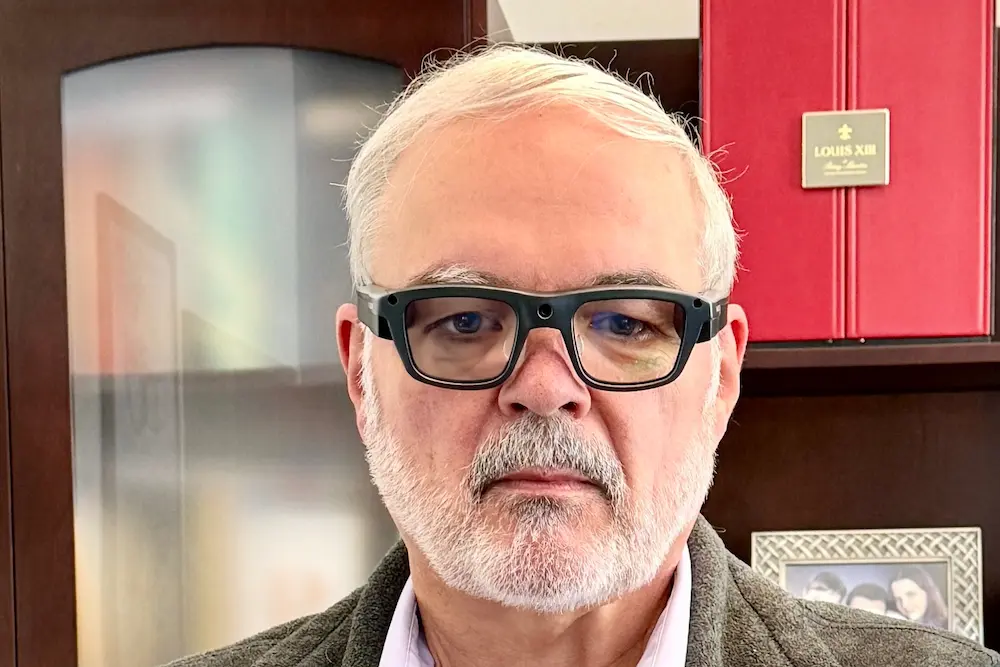
Vuzix CEO Paul Travers speaks to The XR Beat about smart glasses pilots, warehouse workflows, AI glasses, display technology and what enterprise buyers should understand before choosing a wearable strategy.
Smart glasses seem to be getting pulled in two directions at once. Consumer AI glasses are bringing more attention to wearable interfaces, but enterprise teams are still asking harder questions around workflow fit, device reliability, battery life, security, support and measurable value.
Vuzix aligns more closely with the frontline and enterprise side of the market, with smart glasses used across areas such as warehousing, logistics, healthcare, field service and industrial workflows. The company has also been pushing packaged deployment routes, including all-in-one Solutions Kits that combine Vuzix smart glasses with frontline applications.
The XR Beat spoke with Vuzix CEO Paul Travers, about why smart glasses are becoming more commercially grounded, why pilots stall, where buyer pull is strongest and what enterprises should understand before backing a smart glasses strategy.
Paul Travers, CEO of Vuzix, has over 30 years of experience in the consumer electronics field, and 26 years of experience in the VR and virtual display fields. Paul has been a longtime leader in the development of AR wearables and their practical applications in enterprise sectors.
The interview has been lightly edited for clarity and length.
Why Are Smart Glasses Starting To Look More Commercially Grounded In Frontline And Enterprise Settings?
What’s changed is that enterprise buyers are moving past the “what if” phase and into operational reality.
A few years ago, most conversations centred around pilots and experimentation. Today, companies are asking much more practical questions: How quickly can this deploy? Does it improve throughput? Can it integrate into existing workflows? What is the ROI timeline?
We’re seeing that especially in logistics, field service, healthcare and manufacturing, where hands-free access to information can create measurable efficiency gains very quickly.
In warehouse environments, for example, visual picking guidance through smart glasses can help reduce errors and improve worker productivity because the information is kept in the user’s line of sight rather than requiring them to look down at a handheld device.
Another important shift is that the hardware itself has matured. Devices are lighter, more wearable, more reliable and better integrated with enterprise software stacks than they were even a few years ago.
At Vuzix, we’ve spent years building products like the Blade and the M-series family for real-world deployment environments, and that operational experience matters because enterprise customers prioritise reliability, usability and long-term support over hype.

I’d also say the market is becoming more realistic. There’s a growing understanding that broader smart glasses adoption will happen in stages.
Outside of enterprise, many first-generation AI glasses are largely audio-first or notification-driven devices. Over time, display technologies like those already in use in enterprise and healthcare will become increasingly important to the broader AR and AI market because visual context supports many of the most valuable use cases.
That transition aligns extremely well with Vuzix’s strengths in waveguides, optics, display systems and complete smart glasses design.
What Separates Pilots That Stay Stuck From Deployments That Move Forward?
The biggest reason pilots fail is that organisations underestimate the operational side of deployment. The technology demonstration may work, but scaling it across a workforce is a very different challenge.
Successful deployments usually have three things in common. First, there’s a clearly defined workflow problem with measurable KPIs attached to it. Second, the solution integrates into existing systems rather than forcing workers to adapt to entirely new processes. Third, the device is comfortable, reliable and practical enough for full-shift usage.
One factor that is often overlooked is change management. Smart glasses deployments are most successful when workers understand how the technology makes their jobs easier, safer or more efficient, and when supervisors are trained on how to incorporate the technology into daily operations.

Another thing we’ve learned over years in enterprise wearables is that customers don’t want to assemble ten different moving pieces themselves. They want a complete solution pathway.
That’s one of the reasons we launched our all-in-one Solutions Kits. They help organisations move faster by packaging hardware, software, communications tools and workflow enablement into a deployable starting point instead of forcing customers into endless customisation cycles.
There’s also a misconception that consumer smart glasses and enterprise smart glasses are interchangeable.
Enterprise deployments require ruggedisation, battery life, security, mounting flexibility, thermal management, long-term support and integration capabilities that are very different from consumer expectations. Buyers who understand that distinction tend to move much faster from pilot to production.
Where Is Vuzix Seeing The Strongest Buyer Pull?
We continue to see strong traction in logistics, warehousing, healthcare, field service and defence-related applications. These are environments where hands-free access to information creates immediate operational value.
Logistics in particular remains very compelling because visual guidance through smart glasses can directly impact picking accuracy, worker efficiency and training time.
We are seeing customers increasingly move beyond limited trials into larger-scale deployments because the ROI can be quantified relatively quickly.
Strategically, Vuzix occupies a unique position in the market because we operate across both finished smart glasses products and the enabling optical technologies behind the industry.
We’re not just building devices; we’re also building the waveguides, optics and OEM platforms that can support future generations of smart glasses.
That’s important because the industry is still early in its evolution. Some companies are positioning themselves around ambitious timelines or broad ecosystem claims, but building scalable, commercially viable, display-enabled smart glasses is extremely difficult.
We’ve spent decades developing expertise in waveguides, optics, manufacturing and wearable systems integration, and that foundation becomes increasingly valuable as the market matures.
How Is The Market Changing As Lighter AI Glasses, Industrial Smart Glasses And XR Headsets Develop In Parallel?
What we’re really seeing is market segmentation, and that’s healthy for the industry.
Lightweight AI glasses are driving awareness and helping normalise wearable interfaces. Many of these first-generation devices focus on audio, notifications, cameras or AI interaction because those experiences are easier to deliver in lightweight consumer form factors today.
Industrial smart glasses serve a different purpose. Enterprise customers prioritise durability, battery life, workflow integration, safety compliance and all-day wearability. Those requirements create a distinct product category that isn’t going away simply because consumer AI glasses are attracting attention.
Then you have immersive XR headsets, which are valuable for training, simulation, visualisation and highly interactive workflows. However, they are generally less practical for continuous frontline use.
Over time, we think these categories will begin to converge in certain areas, especially as display technology improves.
The industry is gradually moving toward lighter, more socially acceptable glasses with increasingly capable visual displays. That’s where color waveguides, advanced optics and mature display ecosystems become critically important.

At Vuzix, our roadmap is built around that expected transition. We’ve already accumulated years of experience in enterprise deployments while simultaneously investing in the optical technologies and OEM capabilities needed for what I would call second and third-generation smart glasses.
We see those future generations becoming much more display-centric, and that’s where our technology stack becomes especially relevant.
What Should Enterprise Buyers Understand Before Choosing A Smart Glasses Strategy?
The first thing buyers should understand is that this is not just a hardware decision. It’s really a workflow and platform decision.
The most successful deployments we’ve seen begin with identifying a specific operational problem that benefits from hands-free visual access to information.
Companies that start with clear workflow objectives generally achieve value much faster than those simply chasing technology trends. This has certainly been the case with our Amazon partnership.
The second consideration is scalability. Buyers should evaluate not only what works in a demo, but what can realistically scale across hundreds or thousands of workers.
That includes supportability, device management, software integration, security, comfort, battery performance, training requirements and long-term product roadmaps.
Enterprise buyers should also involve IT and security teams early. Device management, data privacy, network access and integration with enterprise systems can determine whether a pilot is truly scalable or remains stuck as a limited trial.
Third, companies should think carefully about where the industry is heading.
First-generation AI glasses may be audio-forward today, but display-enabled smart glasses will become increasingly important as AI systems evolve and visual context becomes more valuable to productivity workflows.
Choosing partners with proven optics, waveguide expertise and real deployment experience matters if an organisation wants a strategy that can evolve over multiple hardware generations.
Finally, buyers should avoid assuming there’s a one-size-fits-all wearable. Different workflows require different device architectures.
The right solution for warehouse picking may not be the right solution for remote assistance or immersive training on the defence side. Flexibility and ecosystem compatibility are becoming increasingly important as the market matures.
Images from Vuzix and Samsung