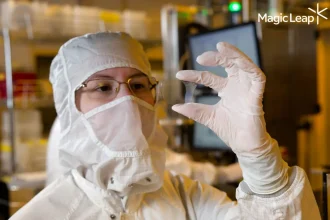

New COO Scott Carden will oversee Magic Leap’s operating plan and waveguide production while the company searches for a new CEO. His promotion follows its move away from first-party devices and 269 planned US job cuts.
Magic Leap wants a leader with experience scaling manufacturing as it searches for a new CEO, according to newly appointed Chief Operating Officer Scott Carden.
In written answers to The XR Beat, Carden explained the thinking behind Ross Rosenberg’s move from CEO to the board:
“With our new focus on supplying waveguides, Ross and the Board determined the company would be best served by a leader with a track record of scaling manufacturing capabilities.”
Carden has been promoted from SVP of Display Engineering and Manufacturing to COO. He will oversee Magic Leap’s operating plan, waveguide engineering and manufacturing, with responsibility for increasing production and delivering its cost and performance roadmap.
Magic Leap’s leadership change comes two months after it stopped pursuing first-party devices and recast itself as a supplier to companies building AI display glasses. Direct sales of Magic Leap 2 ended on 31 March, although authorised resellers can continue selling the enterprise headset until the end of 2026.
A Manufacturing Exec Takes Operational Control
Carden joined Magic Leap in 2015 and has led work across equipment, materials and process engineering for research, development and manufacturing. His promotion ties the company’s daily operating plan directly to the factory and engineering work behind its supplier model.
Magic Leap’s announcement gives him three specific jobs:
- Increase production
- Deliver the waveguide cost and performance roadmap
- Meet partners’ product requirements and timelines
Carden said his priorities over the next year include advancing partner programmes and improving factory performance.
“Over the next 12 months, that means moving partner programs closer to volume production while continuing to improve manufacturing yield and efficiency.”
He didn’t identify the programmes or commit to reaching volume production within that period. Device makers still need consistent optical quality, predictable yields and production schedules they can build a launch around.
Carden used his own LinkedIn announcement to emphasise Magic Leap’s “purpose-built waveguide manufacturing process” and its claimed cost, scale and performance advantages. He said the company’s manufacturing base was the source of his confidence in the work ahead.
The $100 Display Target Moves into Operations
Carden reaffirmed the $100 benchmark for the full display system, which he first discussed with The XR Beat in July.
“Optical performance may prove what is possible, but cost determines whether a product can reach consumers.”
He said Magic Leap’s waveguide technology and manufacturing expertise were intended to help partners close that cost gap.
The figure applies to the complete display system. A finished pair of glasses also has to absorb the cost of frames, sensors, compute, battery, audio, connectivity, software, fitting, distribution and support.
Magic Leap says its Jet and Flash Imprint Lithography process, known as J-FIL, uses fewer production steps than competing methods. The company claims shorter manufacturing cycles, higher yields and lower unit costs, while maintaining the field of view, brightness, resolution, eyebox and colour performance required by display glasses.
Carden now owns the operating plan behind those claims. Magic Leap hasn’t published its current production capacity, manufacturing yield, unit cost or order volumes. Its July announcement offered waveguide samples in several field-of-view options, which gives potential customers hardware to evaluate before committing to a product programme.
Moving from samples to a commercial order requires qualification work, integration with a light engine, reliability testing and confidence that performance won’t drift between batches. Carden’s new role connects those factory requirements to the company’s senior operating decisions.
The XR Beat has previously covered Magic Leap’s $100 display-system target and the company’s move away from first-party headsets.
Rosenberg Moves to the Board After the Supplier Pivot
Ross Rosenberg became Magic Leap CEO in November 2023, when the company was focused on expanding commercial adoption of its enterprise AR platform. He had previously held operating and strategy roles across Bain Capital’s software portfolio, Belden, First Solar and Danaher.
His tenure ended with a different Magic Leap. The company stopped direct sales of Magic Leap 2, committed its future to waveguides and device integration, and announced a substantial restructure.
Florida WARN records disclosed 193 planned job cuts at Magic Leap’s Plantation headquarters on 1 and 2 October. A separate California filing added 76 planned cuts at its Sunnyvale site, taking the known US total to 269.
Magic Leap told The XR Beat in July that the organisational changes aligned the company with waveguide manufacturing and device integration. It didn’t disclose how the cuts were divided between teams or whether partner programmes would be affected. The company said any future growth and development would support waveguide manufacturing, without giving hiring figures.
Rosenberg will continue advising Magic Leap from the board on its role as a waveguide supplier. The company described its strategy as defined and said the incoming CEO would inherit strong momentum, although it provided no revenue, pipeline or production-volume figures.
Carden said he would keep the operating plan moving and deliver against partners’ requirements and timelines during the CEO search. His response did not identify an interim CEO or clarify who holds final day-to-day executive authority.
Google and Pegatron Move from Credentials to Delivery
Magic Leap already has two major relationships around its supplier plan.
Its three-year collaboration with Google combines Magic Leap waveguides and optics with Google’s Raxium microLED light engine. The companies showed an AR glasses prototype and Android XR reference design in October 2025.
Magic Leap also signed an agreement with Pegatron in December 2025 covering production of AR glasses components, including waveguides. Pegatron brings high-volume electronics manufacturing experience, while Magic Leap contributes the optical design and production process.
Neither announcement named a finished product scheduled to use Magic Leap waveguides or disclosed an order volume. Google and Pegatron provide technical and manufacturing credibility, while commercial proof still depends on products reaching production.
Prospective customers will want measured performance across batches, verified yields, firm prices and dependable delivery dates. The incoming CEO will inherit a supplier business built around other companies’ product schedules, and Carden will run the manufacturing work needed to meet them.
Magic Leap has credible partners and more than a decade of optical engineering behind it. It still needs to show how many waveguides it can ship, at what yield and cost, and which commercial products will carry them.