The Augmented Enterprise Summit began in 2015 with companies testing Google Glass. Looking ahead to this year’s Atlanta event, the organizers open up about their shift toward advanced tech like AI and digital twins, and the persistent rollout challenges companies are still facing.
In 2015, BrainXchange kept reading reports that Google Glass was a failure. Privacy concerns and the awkwardness of wearing a camera on your face were getting plenty of attention.
The team also found airlines, ambulance services and HVAC businesses exploring whether the glasses could help people do their jobs.
Those early experiments helped inspire the Enterprise Wearable Technology Summit, now the Augmented Enterprise Summit. Eleven years later, the event takes place in Atlanta from 13–15 October; covering AI, XR and digital twins.
I sat down with Emily Friedman and Israel Mejia from BrainXchange for a look behind the scenes of the event, discussing everything from their core audience to the hurdles modern companies are facing.
Emily Sitnikova, Head of Content at BrainXchange:
“A lot of those early Explorers were actually companies. Fortune 500 companies that were saying, ‘Here’s this new tool. Let’s see if we could use it for anything.’”
AI and Digital Twins on the Agenda
The first event covered glasses, watches and other wearables people could use at work. XR took up more of the programme as companies developed headset applications. Digital twins and AI have featured more heavily over the past two or three years, according to the organisers.
Some sessions now cover AI within XR applications, while others focus on AI on its own.
Emily explained:
“We just follow the space and we follow what companies are doing today and what they’re using and what’s actually getting adopted.”
A team developing immersive training might also be exploring generative AI, while another combines reality capture, digital twins and visualisation. Augmented Enterprise has expanded its programme to cover how companies use these tools together.
Deployment Problems Cross Industry Lines
Attendance has grown from roughly 300 people at the first event to more than 1,000, the organisers say. The audience now includes senior decision-makers, technical specialists and the people designing and delivering applications.
Healthcare attendance has varied over the years, and more universities have been taking part recently. Teams working in different industries often run into similar problems when they introduce the technology.
“The applications are really the same and the challenges are pretty similar from industry to industry. It’s just the individual environments that are changing.”
A manufacturer and a hospital have different operating requirements, but both need funding, employee buy-in and a use case they can deliver. Someone outside your sector may have already dealt with the funding or rollout problem holding up your project.
No Sales Pitches: Just Real Deployment Stories
The organisers estimate that enterprise end users make up 75% of the audience, and most speakers come from companies using the technology. They want speakers to cover failed attempts and deployment problems as well as the projects that worked.
Emily said:
“Companies get on stage and they’re really honest about what works and what doesn’t.”
Sponsors do have sessions of their own, including the opening keynotes, but BrainXchange says it encourages them to talk about customer applications. Attendees can also see demonstrations and speak to suppliers in the exhibition hall.
Proving ROI, getting employees on board and choosing the right first use case keep coming up. The organisers also hear from teams whose pilots worked but haven’t led to a wider rollout.
In XRB’s reporting from AWE 2026, ArborXR CEO Brad Scoggin described weak ownership, poor ROI tracking and integration problems holding back deployments. Attendees can ask enterprise teams who owns an XR programme and how they handle support.

First Pilots and Wider Rollouts
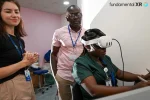
Attendees can also try the equipment. Buying a headset or wearable means understanding what it’s like to use, alongside the software and support it needs.
Israel Mejia, who works with Augmented Enterprise sponsors and exhibitors at BrainXchange:
“I’m just excited to see all the technology in-person in one room.”
Teams starting out can ask how others chose and funded their first use case. Teams planning a wider rollout need answers on costs, employee adoption and who’ll support the system once it’s in use.
Augmented Enterprise Summit 2026 takes place in Atlanta from 13–15 October. View the programme and registration options, or apply for a complimentary guest pass if you’re an eligible enterprise end user. Guest passes are limited and subject to approval.
The XR Beat is a media partner of the Augmented Enterprise Summit.