
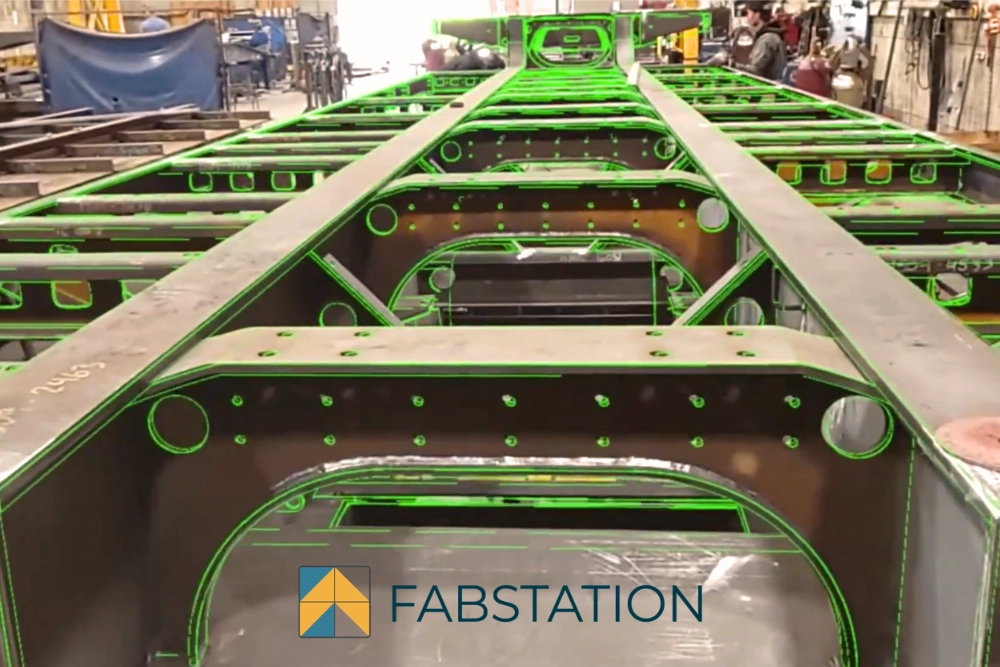
FabStation overlays a steel assembly’s 3D design onto the physical workpiece so workers can spot missing, misplaced or reversed parts. CEO Randy Warnaar says the approach can shorten inspections and catch errors before they become expensive rework. His examples also show why the overlay needs conventional measurement, clear reporting and support from the people using it.
FabStation won Best Enterprise Solution at the 2026 Auggie Awards for an augmented reality system built around a costly steel-fabrication problem: errors often become harder to fix with each production stage they survive.
A misplaced plate can still be adjusted during fit-up, when parts are temporarily tacked in place. The same error becomes a labor-intensive repair after welding, painting or delivery. Once the steel reaches a construction site, one component that doesn’t fit can hold up a crane, an installation crew and the work that depends on it.
FabStation CEO Randy Warnaar told The XR Beat that the software can reduce a thorough inspection of a 10-meter column with 20 to 30 parts from roughly 30 to 40 minutes to between five and eight minutes. The figures are based on FabStation’s own benchmark and will vary by assembly and workflow.
You can see the full XR Beat interview with Randy here.
The product grew from Randy’s experience inside steel fabrication rather than a general attempt to find a market for AR. His father started a fabrication company in British Columbia more than 40 years ago, and Randy worked across the business, cleaning beams early on and later moving into management.
How FabStation Uses 3D Models on the Shop Floor
Steel fabrication has used building information modeling and 3D design for decades. Randy says the problem appears when the information reaches the people making the physical assembly.
Office teams can navigate a detailed 3D model, while fabricators may still work from flat drawings and infer the design intent. Near-side and far-side components can be confused, plates can be turned 180 degrees, measurements can be misread and smaller parts can be missed.
Randy said:
“There’s all this rich 3D model data that’s trapped in the office. The people who actually build it have to build from 2D schematics still.”
FabStation brings the design model to the workpiece during fabrication and inspection. The workflow follows the kind of task-specific guided work identified in The XR Beat’s review of the most deployable enterprise XR use cases in 2026: a worker gets visual information against the object they need to check, with a measurable operational result attached.
How the AR Inspection Works
In our July interview, Randy said FabStation could run through an iPad Pro, HoloLens 2 or Magic Leap device. A QR code localizes the model before the operator visually aligns it with the physical assembly and makes finer adjustments.
FabStation claims tracking accuracy of 1.5 millimeters across a 10-meter object once the model has been aligned. The overlay can reveal a component that is missing, shifted or placed on the wrong side.
Randy explained:
“Once you have that model overlaid, you’re basically playing a game of spot the difference between the model and the actual workpiece.”
“The tape measure is still the primary means for inspection. We’re helping speed up the process of finding where these problem areas might be.”
A junior worker can carry out the first visual check and involve an experienced tradesperson when something needs closer examination. Fabricators still need to decide how the AR check fits their quality assurance program, which measurements require calibrated equipment and who can approve an assembly.

Earlier Errors Cost Less to Fix
Fit-up offers the cheapest opportunity to correct an assembly because the parts have only been tacked into place. Errors found after full welding may require the weld to be gouged out before the work can be rebuilt. Painting and transport add further cost.
Site delivery creates the most expensive version of the problem. Randy estimated that a crane alone could cost $300 to $400 an hour while a crew waits for a component to be repaired or replaced.
FabStation also supplied an unnamed customer example. Randy said the organization has around 3,000 employees and found errors in assemblies that were close to being loaded onto a truck during his initial demonstration.
The customer later tracked similar discoveries in a spreadsheet and calculated that one headset had prevented roughly $200,000 to $300,000 in rework and related costs over a year, according to Randy. It has since increased its deployment to around seven headsets.
The customer was not named, so The XR Beat couldn’t independently verify the saving. Fabricators assessing the product would need to run the same calculation against their own error rates, labor costs, inspection times and site penalties.
A Flagged Error Still Needs to Reach the Right Person
Finding a mismatch through AR only solves the first part of the problem. A deficiency can still reach the truck if the worker marks the steel, leaves to find a colleague and another team moves the assembly before it is fixed.
FabStation has expanded beyond the visual overlay into production tracking, inspection reports and deficiency management. Randy said its manufacturing execution software can mark an assembly as deficient and prevent shipping until the problem has been rectified:
“Once you’ve identified the error, you need a way of reporting it and a way of having it get back to management so that they can actually make sure they do something about it.”

The software also records where an assembly sits in the production line and whether it is likely to make the truck on time. Production and quality-control data is captured while workers use the inspection tool, reducing the need for a separate barcode-scanning or reporting step.
FabStation’s expansion into deficiency management is commercially more important than another polished AR overlay. Fabricators need the error to remain attached to the assembly until someone fixes and approves it.
Shop-Floor Buy-In Starts Before Purchase
Randy said adoption varies with the culture of each fabrication shop. Deployments face greater resistance when management selects a tool without involving the people expected to use it.
FabStation brings shop-floor workers into early customer calls so they can see how the process will change and take part in the decision. The approach echoes AREA executive director Mark Sage’s warning that enterprise AR pilots stall when ownership, workflow integration and user involvement remain unresolved.
Randy said:
“If they’re going to make a decision to bring these tools into their shop, we want to make sure that the people who are ultimately going to use them want to use them.”
Fabricators evaluating FabStation should compare the overlay against their existing inspection tolerances, measure inspection time on representative assemblies and track where each discovered deficiency would otherwise have been found. Our enterprise XR buying checklist covers the wider integration, support and ownership questions to settle before a rollout.
Which Files, Hardware and Costs Should Buyers Check?
FabStation’s product documentation lists KSS, PDF and IFC files for its detailing workflow and describes subscriptions priced per device, with web-portal access included. Hardware is purchased separately, so a proposal needs to identify the glasses or tablet, software tier, training and support being supplied.
A pilot should use assemblies that reflect the shop’s actual tolerances, lighting and working distances. Teams can then compare the time needed to align and inspect each assembly, record the errors caught, and check that a flagged deficiency stays visible until someone corrects and approves it.
Inspection-time savings and avoided rework are different measures. An error caught before shipping may be valuable, but the estimate needs to account for the repair that would actually have been required and avoid counting the same saving twice.


