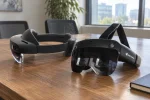
Smart glasses spending on major Chinese platforms has more than doubled. RayNeo, Alibaba and XREAL are pursuing growth through displays, AI and international partnerships, although Meta retains a substantial shipment lead. What next for Chinese smart glasses?
Smart glasses sales value on selected major Chinese platforms rose 120% year-on-year between January and August 2026, according to figures published by China’s Ministry of Commerce on 20 September.
The figure measures spending across the platforms tracked. The release provides no unit total or brand breakdown, so it cannot establish which manufacturers benefited most or whether they are gaining customers abroad.
Chinese smart glasses manufacturers already occupy several positions near the top of the global supplier rankings. Their products range from portable cinema screens to camera-free displays and AI assistants connected to shopping services. Some are also working closely with the US companies they might otherwise be expected to compete against.
Growth Comes with Competition
IDC’s Q2 2026 figures show global headset and glasses shipments grew 35.3% year on year. Four Chinese companies followed Meta in the ranking:
| Vendor | Global Shipment Share, Q2 2026 |
|---|---|
| Meta | 68.7% |
| RayNeo | 3.6% |
| Alibaba | 2.6% |
| XREAL | 2.5% |
| Xiaomi | 2.3% |
| Others | 20.4% |
These figures combine XR headsets, displayless glasses and display glasses, i.e. they measure a broader market than AR glasses alone.
Meta retains a substantial lead, and IDC also reported that Xiaomi’s share nearly halved as competition in China intensified. A fast-growing domestic market can still be difficult for individual suppliers.
Companies can build substantial businesses around different types of glasses, too. Someone buying a portable display for travel may have little interest in a camera or voice assistant, and a business buying live translation has another set of requirements.
Manufacturers will need to establish which tasks their products handle well enough to justify the purchase and continued use.
Chinese Smart Glasses: Homegrown Hardware, International Partners
XREAL’s forthcoming Project Aura combines its hardware with Google’s Android XR and Gemini, alongside Qualcomm processors. XREAL and Google demonstrated the wired glasses in May and announced a developer programme ahead of a planned global launch during 2026.

For XREAL, the partnership offers access to Google’s software platform and AI services. Google gains another manufacturer building for Android XR. Commercial success could expand both companies’ reach, with Google providing software on a Chinese company’s device.
RayNeo’s X3 Pro also combines Chinese hardware with international technology. Its specifications list colour microLED displays, Gemini Live, Qualcomm’s Snapdragon AR1 Gen 1 processor and a Sony camera sensor.
A Chinese smart glasses brand gaining international customers could therefore help a US software company gain users. Google could benefit from successful Chinese hardware even as those devices compete with other American brands.
Software integration remains unfinished. RayNeo’s own FAQ acknowledges that Gemini can answer a request without passing the resulting action to another app, such as navigation. An assistant that can discuss a destination and one that reliably starts directions offer different experiences.
For manufacturers, making those features work together could become as important as improving display specifications, because customers buying assistance will expect the device to complete the task.
Alibaba Brings Its Own AI Business
Alibaba launched Qwen-powered Quark glasses in China in November 2025.

Its wider AI strategy extends into services people already use. In its August results, Alibaba described deeper connections between the Qwen app and Taobao, Tmall and instant commerce.
Glasses could become another way to access those services. An assistant connected to shopping offers a potential source of revenue beyond the device sale, although the commercial case will depend on customers choosing to use it regularly.
Alibaba can develop the hardware experience around its own AI and commerce businesses. International expansion would require more work: a device can be sold abroad before its shopping, payments and other services have equivalent local coverage. Reproducing the experience may require new integrations and commercial agreements in each market.
Other Chinese suppliers are building application tools. Rokid has published AIUI developer tools for glasses applications.
Specialist Brands Explore Different Uses
Even Realities and MemoMind illustrate the range of designs being developed alongside the suppliers with greater recorded shipment share.
Even’s G2 and MemoMind One both use displays without cameras, with functions including translation, prompts and meeting assistance. MemoMind also includes speakers and emerged from a project rooted in XGIMI’s optics research.
For someone who wants captions or notes, a camera may be unnecessary. Removing it changes what the product can capture and how comfortable other people may feel around it. Audio recording and transcription still need appropriate controls.
Workplace demand also needs to translate into measurable benefits. Even Realities COO Li Wang told The XR Beat it was still collecting evidence and did not yet have solid enterprise metrics.
Investment extends to the parts inside the glasses. On 15 September, microLED developer Raysolve announced nearly RMB100 million in funding and said it was working with European and US companies on AR/MR prototypes.
Privacy Could Shape Overseas Sales
Glasses that transcribe meetings, translate speech or send images to AI services can handle commercially sensitive information. Overseas buyers may like the product but still hesitate over the companies processing that information.
China’s legal framework adds a specific concern. UK government guidance says organisations operating in China can be required to cooperate with state intelligence work, potentially including access to data. It also identifies the absence of a formal mechanism to challenge those requests.
In my interview with Even co-founder and COO Li Wang, I asked directly whether the company’s team in China could access user information. She said no. Wang also said Even did not retain raw audio and that users could choose local transcription on their phone or cloud processing.
Those are company assurances, but buyers considering confidential work would need the supporting detail on access controls, service providers and whether local processing can be enforced across a deployment.
A waveguide manufactured in China tells buyers little about who receives a meeting transcript. However, a familiar American brand also needs to explain its recording, retention and AI-training policies.
Chinese suppliers could turn scrutiny into a commercial advantage if they offer controls that customers can verify, but unclear or ambiguous answers about remote access or government requests could instead restrict their reach, particularly among employers handling sensitive information.
Can Growth at Home Travel Abroad?
My expectation is that Chinese suppliers will become more influential in smart glasses through a combination of their own brands, international software partnerships and components inside other companies’ devices.
Their progress could produce different outcomes for American companies. Google could gain users through Chinese hardware running Android XR or its AI services. Meta could face more alternatives competing for the same customers. Alibaba has an opportunity to build a separate hardware-and-services business around Qwen, although taking its commerce integrations abroad would require additional partnerships.
Distribution, prescription fitting, price and support will still affect how far those products travel. Privacy could influence which of them are accepted into workplaces. Chinese brands with clear, verifiable controls may be able to answer buyers’ concerns; suppliers that leave data access unclear could struggle even with competitive hardware.
I think Chinese brands can build international businesses around particular uses while Meta retains its lead. For workplace sales, a supplier that gives employers verifiable control over recordings and transcripts could win customers who would otherwise choose a more familiar name. A cheaper device or sharper display will always struggle to close the sale if the buyer can’t establish who can access its client conversations
Disclosure: Even Realities has supplied The XR Beat with G2 glasses. The publication has no paid sponsorship arrangement with the company.