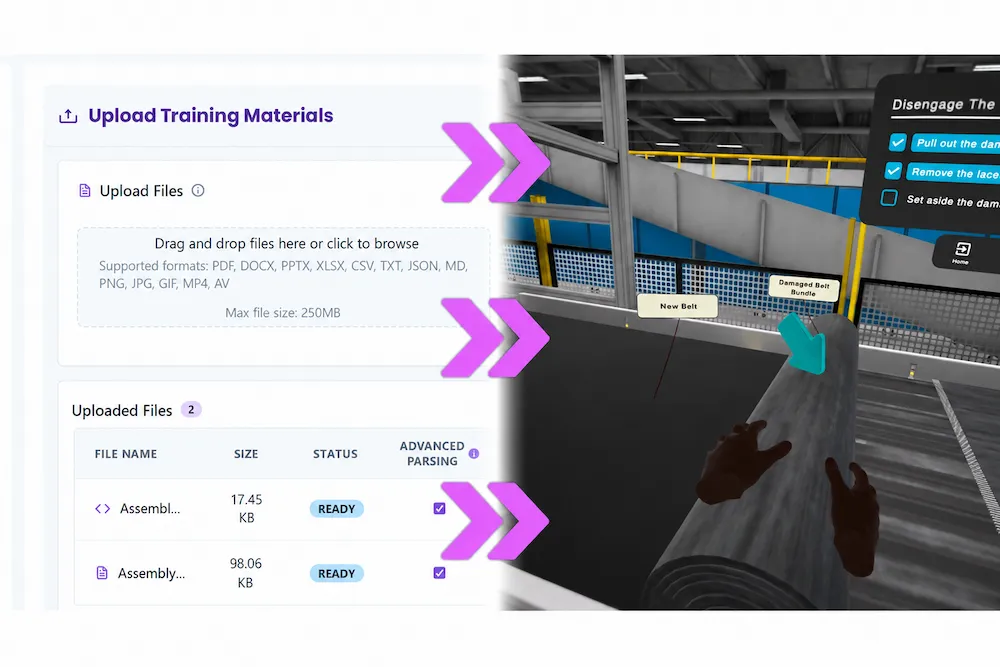
AutoVRse wants to turn the training manuals companies already have into VR exercises they can build and update themselves. Cutting the development bill could help more employers afford training tailored to their own workplaces, but its headline saving comes from internal project comparisons, with no published breakdown of the results yet.
AutoVRse says its VRseBuilder platform can reduce custom VR development time by up to 93%, using AI to turn standard operating procedures and training requirements into editable modules.
In its 28 September announcement, the company describes a workflow combining AI-assisted authoring, reusable software components and connections to the Unity development engine. Training teams can review the output in a headset and adjust the scenario before deployment.
Faster authoring could help employers build training around procedures that have been too expensive to commission individually. It could also make revisions more affordable when equipment, site layouts or working instructions change. The saving will depend on how much of that work the platform handles and how much remains with developers and training specialists.
Putting Claude to Work in Unity
VRseBuilder starts with a procedure, process description or training objective. AutoVRse’s Studio page describes converting documents into a training flow, adding 3D assets, refining the experience and publishing it for testing. Teams can use the company’s asset library or bring in their own environments.

AutoVRse also connects AI assistants such as Claude and Cursor to Unity through the Model Context Protocol, or MCP. The connection lets an assistant operate development tools as part of building an experience.
The company’s public Unity plugin documentation describes controls for creating scenes, changing objects and components, importing assets, editing scripts and producing application builds. The plugin works with a companion server that connects the assistant to the editor.
For a team already developing in Unity, those capabilities could reduce repetitive setup work. A training designer could ask for a change, review the result and refine it while a developer concentrates on interactions the standard components can’t handle.
The public installation instructions still require a Unity project and software setup. Organisations should establish which work their training team can complete independently and which tasks need AutoVRse or an internal developer.
VRseBuilder was already being demonstrated before today’s announcement:
“VRseBuilder MCP makes trying cheap,” he wrote.
93% – An Impressive Figure That Needs Qualifying
AutoVRse says the percentage comes from its analysis of client project timelines. The announcement doesn’t give the number of projects, the typical saving or a breakdown of which stages were included.
A development-time reduction doesn’t establish the same percentage reduction in the total training budget. Employers also pay for preparing source material, reviewing procedures, producing specialist assets, testing with workers, supporting devices and maintaining the finished module.
For a credible comparison, a buyer would need the same training scope and acceptance criteria on both sides. A first working prototype and a module approved for use across several factories are different delivery milestones.
Recording staff hours through approval would help establish whether faster assembly reduces the final bill. Counting revisions would also show whether a quick first build is followed by substantial correction work.
UltraTech: A case Study
AutoVRse’s UltraTech Cement case study describes more than 40 modules covering safety procedures, alongside deployment across multiple plants and integration with the customer’s existing systems.
UltraTech’s own safety reporting confirms that it uses VR modules to simulate hazardous work, assess understanding and generate reports. Its account establishes an operational use for VR training, although it doesn’t validate AutoVRse’s development-time percentage or isolate the contribution of the current AI tools.
Prospective users can also inspect examples through AutoVRse’s Standard Industry Modules app on Meta Quest, which is listed as early access. The developer describes exercises including manufacturing assembly, warehouse maintenance and pharmaceutical equipment operation.
Trying a finished exercise can help a buyer assess instructions, interactions and suitability for its workforce. An authoring demonstration would then need to show how much work is involved in adapting that exercise to the buyer’s own equipment and approved procedure.
What Happens When the Procedure Changes?
The commercial opportunity extends into the months after a module goes live. Consider a manufacturer that changes one machine component or introduces a revised inspection step. If its training team can update the relevant asset and instruction without commissioning a complete rebuild, it can keep the exercise closer to the work being taught.
Review remains part of that process. A subject specialist needs to confirm that the revised sequence is correct, while representative workers need to be able to understand and complete it. The XR Beat’s reporting on AI-assisted XR testing examines some of the differences between a functioning application and an experience people can use effectively.
AutoVRse’s Pulse analytics product is intended to record task-level performance, including time taken and procedures skipped. Training teams could use that information to identify steps that need more explanation, then check whether a revision improves performance.
AutoVRse is inviting organisations to request a free trial. A practical evaluation could follow one approved procedure from source document through authoring, review and delivery, recording the staff time required at each stage.
Before extending the work, ask for the cost and process of revising that procedure, deploying it at a second site and exporting the training records. Those terms will help determine whether the first module can become a maintainable training programme.