
AstraZeneca’s AR wayfinding and Metro-North’s VR training are among the case studies coming to Atlanta’s Augmented Enterprise Summit. Google and Samsung will discuss workplace uses for Android XR, while the opening keynotes tackle physical AI and the cost of reusing 3D data. The event runs October 13–15 at the Atlanta Marriott Marquis.
AstraZeneca’s AR wayfinding system maps more than 7,000 assets. Its job is to guide technicians and quality-control staff to the valve or sample port they need.
Danny Allen, the company’s associate director of digital products for XR, will explain how the system grew beyond its pilot in an October 13 case study. The session covers the practical decisions behind that expansion, including how the team judged when the technology was good enough to use.
The conference that began with Google Glass experiments now brings those deployment accounts together with demonstrations of newer technology. This year’s program includes companies building their own VR training and others reconsidering the suppliers that helped them get started.

AI Assistants from Hitachi and Convai
Event organiser BrainXchange’s Emily Friedman expects more crossover between AI and immersive technology this year:
“I’m looking forward to hearing a little bit about how AI and XR are starting to come together.”
Hitachi/LANDCROS will present its AI Assist Pro work alongside Ramblr, NVIDIA and Dell. The session covers taking visual intelligence into production for heavy-equipment tasks, with wearable devices among the planned next steps.
Ramblr’s published account of the project describes an assistant that draws on Hitachi’s technical and product information to answer questions on mobile devices. A technician can submit a photo of a component or ask for help with an unfamiliar machine.
A technician could ask about a machine while standing beside it, with the assistant drawing on information specific to that equipment.
Convai’s Purnendu Mukherjee will address a related application on October 15: AI assistants that use live video and a company’s existing technical files to help workers during a task. His session includes examples from aerospace and semiconductor manufacturing.

Metro-North’s VR Training Across Eight Locations
Metro-North Railroad’s Lorne Lieb and Luca Spensieri will describe how an internally developed VR training program expanded across eight locations.
Their October 14 presentation covers training for hazardous environments and equipment that isn’t readily available for practice. The team uses its own VR content alongside interactive 3D mapping, with the session following the process from identifying a training need through to evaluating the result.
A case study published by training platform Uptale describes Metro-North scenarios covering track safety and handling aggressive passengers. Lieb said:
“I watched a room full of seasoned, somewhat jaded track employees walk out of a VR session smiling.”
For training teams, the in-house development work deserves attention alongside the experience in the headset. Someone has to update the material when procedures change and make it usable by instructors at another site.
Niantic Spatial on Physical AI, Unity on 3D Assets
Niantic Spatial CEO Inhi Cho Suh will open the first day with a keynote on physical AI. Her session addresses the gap between a digital representation of a place and the environment a person or machine actually encounters.
A detailed model can become outdated when equipment moves or a site changes. Keeping that model current is part of the ongoing cost of using it for navigation or automation.
Unity’s Sarah Lash opens day two with a keynote on building repeatable 3D programs. She’ll address the repeated conversion and rebuilding of assets when different teams need the same engineering data.
A model prepared for a design review may later be needed for training. Reusing it can avoid another round of preparation, provided teams can identify the approved version and carry changes through to the applications using it.
Johnson & Johnson MedTech on VR Suppliers
Johnson & Johnson MedTech’s Sean Peterson will examine a purchasing decision that can arrive after a VR program succeeds.
His October 15 session covers moving from an integrated supplier to a modular setup, where specialist vendors handle different parts of the program.
An early partner may help an organization get its first application running. As the deployment grows, a customer might, for example, want to choose its device management separately or change how content is developed.
Teams planning life after HoloLens already face decisions about preserving software investments while changing hardware.
Android XR and Hands-On Demos
Google’s Hugo Swart will present Android XR’s enterprise development options and device-management capabilities on October 13. Samsung’s Cheri Malo and Christine Ladd will also lead a session on Galaxy XR and its workplace applications that day.
The sponsor and exhibitor roster includes PICO XR and XREAL, alongside software providers such as Campfire and frontline.io. ArborXR and ManageXR will also be there for attendees assessing how to run and support a fleet.
Friedman is keen for visitors to try the equipment:
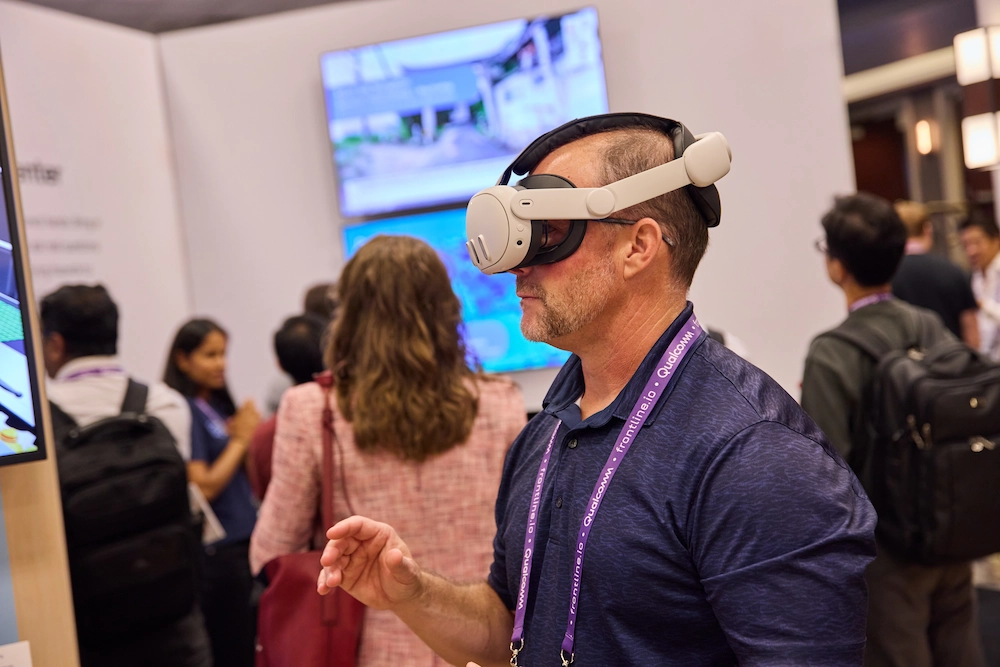
“You gotta put on the glasses, you gotta put on the headset.”

Israel Mejia, who works with the event’s sponsors and exhibitors, also described looking forward to seeing the technology in person after spending months discussing what companies would bring.
For a buyer, a demonstration is a chance to work through the task they expect employees to perform. Ask to see how a session starts and how a colleague takes over the device afterward. If the application needs specialist help to run, establish who’ll provide it.
Augmented Enterprise Summit takes place October 13–15, 2026, at the Atlanta Marriott Marquis. The full program is available online, and eligible enterprise end users can apply for a guest pass, subject to approval.
Before committing to a pilot, ask the supplier to demonstrate your intended workflow and agree how you’ll measure the result.
The XR Beat is an official media partner of the Augmented Enterprise Summit.


