AMD has agreed to buy Fei-Fei Li’s World Labs for $8.2bn, bringing research into AI-generated 3D worlds closer to its processor business. The acquisition could strengthen competition with NVIDIA in the technology behind robotics, industrial simulation and immersive applications, as chipmakers compete to supply the models and software developers build around.
AMD has signed a definitive agreement to acquire World Labs in an all-stock transaction valued at approximately $8.2bn.
Announced on 28 September, the deal is expected to close by the end of 2026, subject to regulatory approvals and customary conditions. World Labs co-founder Fei-Fei Li will become AMD’s executive vice-president and chief scientist after completion, reporting to chair and CEO Lisa Su.
A Familiar Partnership
World Labs develops AI that can generate and reconstruct three-dimensional environments from text, images and video. AMD plans to use the team’s research to inform future hardware, software and system designs.
Lisa Su, chair and CEO of AMD, said:
Building the compute platforms for the next generation of AI requires a deep understanding of how models are evolving.
The companies already work together. World Labs says their technical partnership began last year, with training and inference optimisation on AMD GPUs. Joining AMD would bring the researchers developing those models directly into the business designing the processors.
Competing for the Same Developers
NVIDIA already has Cosmos world models for physical AI, including simulation and robot training. Its software helps developers create applications that can run on its computing platforms.
Patrick Moorhead, Founder and Chief Analyst at Moor Insights & Strategy, wrote in his reaction to the acquisition:
This is a talent and model-insight buy, not a revenue play. AMD gets the people building the models its future chips will have to run.
Moorhead sees the purchase as an investment in research talent and understanding future computing requirements. He also stresses that AMD still needs a major robotics customer to demonstrate commercial progress.
For AMD, owning a model developer could help it anticipate the computing demands of emerging 3D applications and optimise its hardware around them. XR suppliers could benefit from models that run more efficiently on AMD hardware, expanding their options when comparing the cost and performance of competing systems.
Marble Already Works in VR
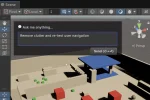
World Labs’ technology already reaches immersive applications. Developer Daniel Skaale used its Marble tools to create environments for Splat World, a Unity-based VR experience tested primarily on a PC-connected Quest 3.
Skaale added custom tools for lighting, physics and interaction, illustrating the development work required to turn generated scenes into an application.
HTC’s VIVE Mars team has also used Marble-generated environments in virtual production. World Labs’ newer Atlas model extends its work in generating and reconstructing 3D spaces.
XR studios could benefit if AMD turns that research into faster, cheaper ways to create and run immersive environments. The acquisition doesn’t yet establish those savings. Engine compatibility, licensing, computing costs and production support will determine whether developers can use the technology commercially.