
Amazon has responded to The XR Beat after a Bloomberg interview raised concerns about image capture around customers’ homes. The company says unblurred originals aren’t stored and third parties don’t process or review the imagery. Its reply didn’t specify retention periods or customer opt-out arrangements.
Images: Amazon
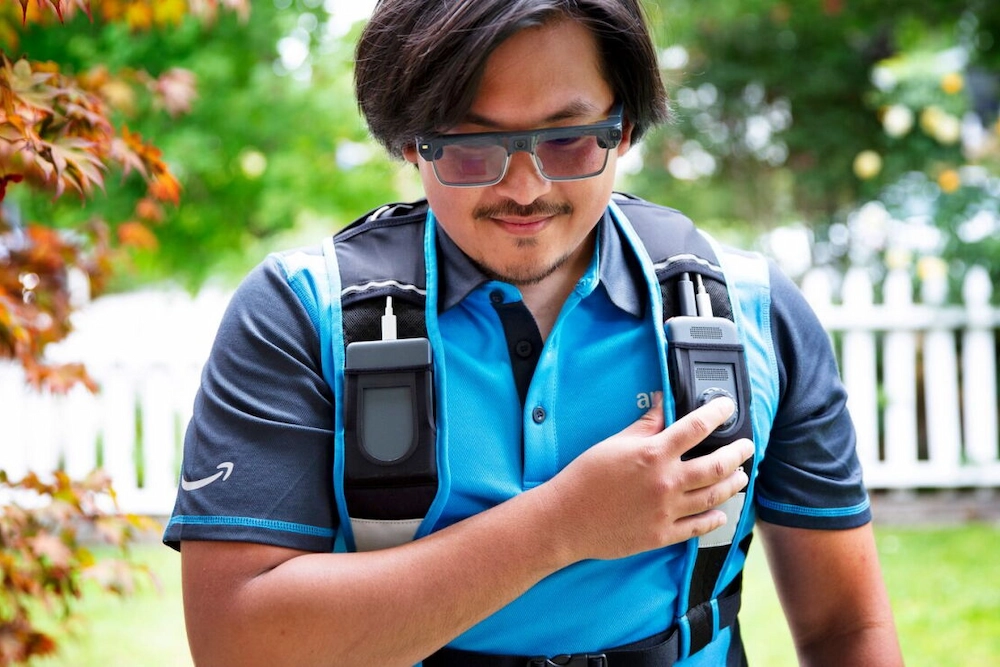
Amazon has defended the privacy protections in its delivery glasses following reports that the devices repeatedly photograph their surroundings while drivers walk to customers’ doors.
In a September 30 Bloomberg Opinion column, Dave Lee reported that a single driver’s shift could generate several thousand still images. Asked whether customers could opt out, Viraj Chatterjee, the Amazon executive running the rollout, told Bloomberg: “We haven’t thought about that.”
Responding to The XR Beat’s questions, Amazon said: “We do not store unblurred originals, and no one can manually review any unblurred imagery.”
The company also said no third parties are involved in processing or reviewing the images.
Leigh Anne Gullett, an Amazon spokesperson, rejected descriptions of the glasses as a surveillance tool:
“The suggestion that Amazon is using smart delivery glasses as a surveillance tool fundamentally mischaracterizes the technology and its purpose… We have built privacy protections into the technology from the beginning, including automatically obscuring identifying information before imagery is available for human use, strict data-minimization and access controls, and a hardware privacy switch.”
Still Images During Deliveries
Amazon’s delivery glasses display walking directions and delivery information in the driver’s field of view. Drivers can scan packages and take proof-of-delivery photos without using their phone.


Amazon told The XR Beat:
“The glasses capture still images, not video, during the walk from the van to the delivery location, along with the proof-of-delivery photo. They don’t capture imagery while the driver travels between stops.”
The company described those images as much lower-resolution than a standard smartphone camera, and said it intends to keep resolution below that of a phone as the technology develops. It didn’t specify a pixel count or how often pictures are taken.
Amazon says the location information helps drivers identify the correct entrance or designated drop spot. Finding the right building is one job; finding the entrance marked “Deliveries” can be a small expedition of its own.
Amazon’s Vision-Assisted Package Retrieval system already uses projected lights to identify the packages for a stop inside a van. The glasses carry hands-free guidance onto the walk to the delivery location.
Blurring Before Human Access
Amazon described when identifying detail is removed:
“Identifying imagery, including people and license plates, is automatically blurred as a first step once imagery reaches our systems, before anyone can access it.”
The company places that step within its systems. Its response doesn’t describe identifying detail being removed on the glasses before images are transmitted.
Amazon also said it collects the minimum necessary data and limits access to the fewest people required:
“No third parties are involved in processing or reviewing this imagery.”
Employers evaluating smart glasses for frontline work need to establish who can see captured images before a device reaches a customer site. A camera used to help an employee do their job can also capture people who have no involvement in that work.
Driver Choice and Customer Controls
Gullett said participation is voluntary for delivery partners and their drivers. She also cited a hardware privacy switch among the protections built into the glasses.
Amazon’s response didn’t set out customer or bystander opt-out arrangements. It also didn’t explain how people are notified about image capture or how they can request access to an image or ask for its deletion.
A workplace policy for camera-equipped glasses should also tell staff how to handle requests from customers or visitors.
More Than 275,000 Deliveries
Amazon says more than 500 delivery associates have tested the glasses over 18 months, completing more than 275,000 deliveries. The company now describes features that warn drivers about a possible wrong-door delivery or the presence of a pet.

Its response to The XR Beat didn’t include measured reductions in delivery errors or time spent at each stop.
Amazon plans to deploy an additional 5,000 devices in 2026 and expand to more than 20,000 devices by the end of 2027. The company confirmed the US pilot in its reply; it didn’t provide a UK rollout timetable.


