World generation and automated VR testing are advancing together. Farclip’s spatial analysis tools offer one approach to checking layouts earlier, while training teams still need evidence that an experience works for the people using it.
World Labs introduced Atlas on 1 September, extending AI’s ability to generate and reconstruct environments from images, video and other inputs. Its demonstrations include generating views of areas a camera never captured and producing 3D scenes from limited reference material.
XR developers have another job once an environment exists: checking whether someone can use it. A training room needs routes people can follow, equipment they can reach and instructions they can find. Each new variation creates more work to review.
AI suppliers are starting to automate parts of that work. Meta has released tools that let agents inspect and interact with VR apps. Farclip, an early-access spatial analysis company, is targeting layout decisions before human playtesting begins.
For studios and enterprise training teams, the potential saving extends beyond the time spent building a scene. Finding a blocked route or confusing layout earlier could avoid another round of changes after users arrive.
AI Agents Can Already Check VR Apps
Meta XR Operator, introduced in August as an experimental tool, allows compatible AI agents to inspect a running app, operate controls and check results in Meta XR Simulator. It extends Meta’s work on AI-assisted VR development.
Meta says the tool works best with static interactions and predictable outcomes. Its published limitations include audio, detailed hand interactions and moving targets. An agent can therefore complete some checks while missing cues that affect a person’s experience.
Developers also have established tools for checking geometry. Unity’s navigation system builds navigable surfaces from scene geometry and supports obstacles and links between areas.
A route through a room can be technically passable while being difficult for a new user to spot. An interactive button can respond correctly while being positioned somewhere the trainee never looks. Automated checks need to cover both the application’s behaviour and the decisions its layout encourages people to make.
A VR Scene Must Support A Real-World Job
Enterprise XR has already exposed expensive differences between fitting objects into a model and completing work around them.
In The XR Beat’s interview with Cintoo’s Dace Campbell, he described a proposed boiler installation that appeared to fit during desktop review. Inspecting the room in VR exposed insufficient access to install and connect the equipment. The team changed the plan before work began.
Generation creates additional checks. World Labs explains that Atlas fills unseen areas with plausible content; supplying more reference images reduces how much it has to invent. A team recreating a particular workplace needs to establish which details came from the site and which were inferred.
Researchers are examining the gap between visual quality and usability too. An April survey of 3D asset generation, currently a preprint, identifies missing production tests covering engine compatibility, physical behaviour and interaction. The authors argue that visual similarity measures cannot establish whether a scene supports the actions required within it.
For a hypothetical maintenance exercise, an attractive plant room would still need the correct equipment, usable controls and enough access to carry out the procedure. A model that flags a narrow passage can help a designer. An instructor must still establish whether the exercise teaches the intended task.
Farclip Analyses Layouts Before Playtesting
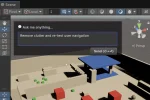
Farclip says its tools analyse scenes inside Unity, Unreal and Godot, with feedback on navigation, visibility and the way people move through an environment. The company describes using scene geometry and visual overlays to help developers examine design decisions while they work.
Alicia Caputo, Farclip’s co-founder, told The XR Beat in written answers that its conversational interface and spatial model perform separate jobs.
“Farclip passes those tasks to its spatial foundation model and returns the results through both language and visual overlays.”
Developers can ask for an analysis in language and inspect the result within the scene. Caputo said the company is also exploring other interfaces with customers because language can be awkward for spatial tasks.
Moving this assessment into the editor could let a team examine several layouts before organising a human test. A designer could check whether moving equipment changes visibility or creates an awkward route, then decide which version merits a trial with users. The saving depends on whether the analysis finds problems the team would otherwise discover later.
Farclip says pilots and customer reports show faster decisions before human playtesting. Asked to substantiate a 70% improvement figure, Caputo did not supply the requested sample, baseline or measurement method. Buyers cannot yet use that figure to estimate a project’s total time or cost savings.
Test the Tool on a Real Training Task
A layout change needs to preserve whatever the exercise teaches. In emergency training, for example, an obstruction may be something the trainee is supposed to navigate. Removing it could make the scene easier while weakening the lesson.
Test the software on a scene with known problems, recording what it catches, what it misses and how long developers spend checking its recommendations. Then involve people who resemble the intended users. Developers know where the controls are; someone entering the room for the first time has to find them.
Deployment also affects the decision. Caputo said Farclip’s standard analysis runs in the cloud, with isolated or on-site options for certain customers. Teams handling client environments need to confirm data retention and model-training terms before uploading scenes.
Compare the total time spent analysing, correcting and testing the scene with the team’s usual process. Buyers need to establish whether the software reduces the hours required to deliver an experience that people can successfully use.